
Goods 3D Sorting: Match Games
Pleasure CityPuzzle
4.94.67K Reviews
- Version
- 1.4.7
- Installs
- 10.00M
- Age Rating
- Everyone
Screenshots
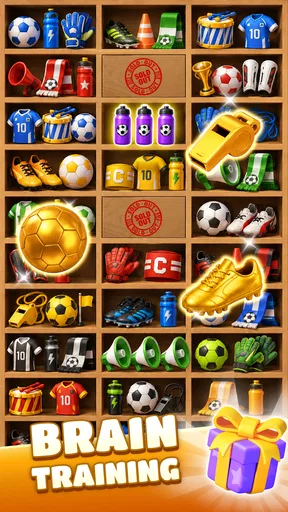
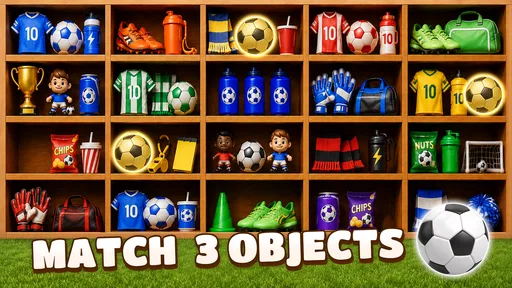
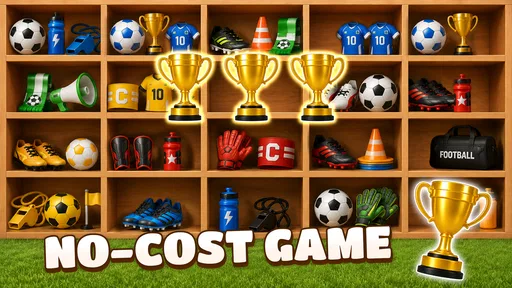
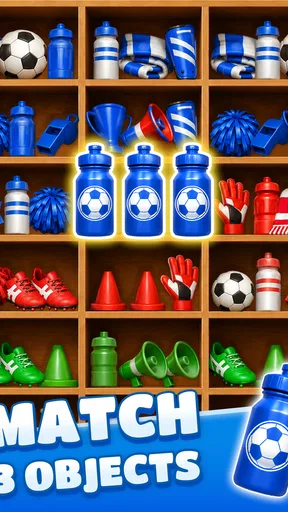
Our Review of Goods 3D Sorting: Match Games
 Analysis by Appyee
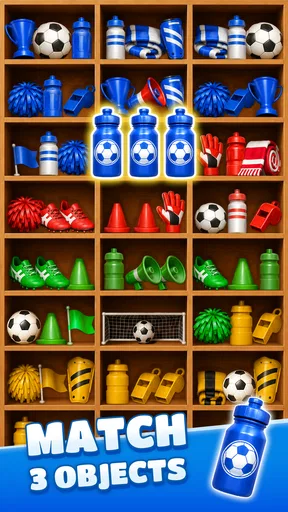
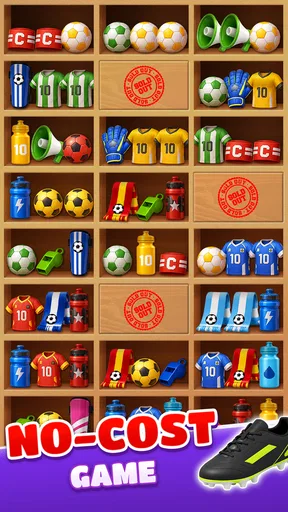
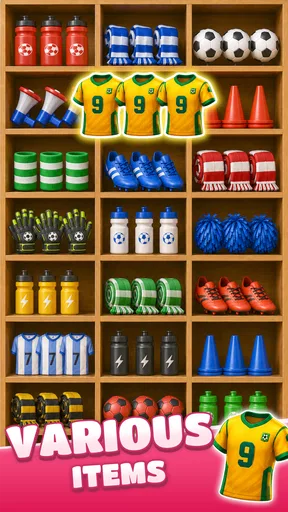
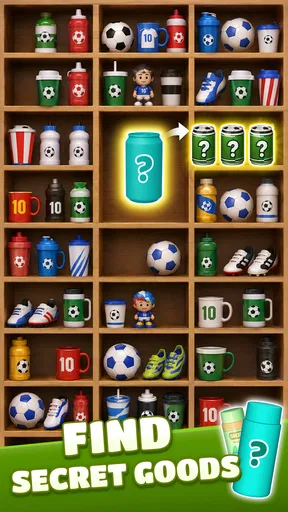
I went into Goods 3D Sorting: Match Games expecting a simple sorting puzzle, and that is exactly where its appeal lies. The game turns arranging everyday-looking objects into a short, focused brain exercise: I look for matching groups, organize the available gear, and try to keep the board from becoming confusing. It is easy to understand within moments, but the decisions become more interesting once several possible matches compete for attention.
This is a free puzzle game from Pleasure City, aimed at Everyone and available for devices running Android 7.0 or later. Its soccer-themed presentation gives the basic matching idea a little extra personality, although the real reason to keep playing is the satisfaction of clearing a messy arrangement through careful choices. With an average rating of 4.9 from around 281 thousand ratings and more than 10 million installs, it has clearly found a large audience. My experience suggests that it works best as a casual game for short sessions rather than as a deep strategy title.
Simple goals make the first sessions easy to enter
The opening appeal is immediate: identify useful groups, sort the objects, and make progress without learning a complicated rulebook. That clarity matters on a phone. I never felt that the game was asking me to memorize a long chain of instructions before allowing me to play. The basic objective is visible through the board itself, so the first few attempts feel more like solving a visual problem than studying a tutorial.
The soccer angle also helps establish a light sense of purpose. The game presents itself around soccer fever and training the brain, but it does not require knowledge of the sport. Someone who enjoys football may appreciate the theme, while someone who does not can still understand the puzzle immediately. In practice, the objects and their arrangement carry more weight than the theme, which keeps the game accessible to a broad audience.
What I like about the early goals is that they are concrete. I am not wondering what I am supposed to do next; I am looking at the available items and deciding which group deserves attention. That makes the game suitable for a quick break, a commute, or a few minutes when I want something interactive but not emotionally demanding. It is also a reasonable choice for players who find traditional match-three games too dependent on random board layouts or flashy effects.
The trade-off is that the early simplicity can feel familiar. If you already play several sorting and matching games, the first stages may not seem especially surprising. The enjoyment comes from the tactile rhythm of scanning, selecting, and clearing rather than from a radically new puzzle concept. I would not choose it for a story-driven experience or for complex logic problems, but I would recommend it to someone who wants a clean entry point into casual puzzle play.
Progress becomes visible through better decisions
A good sorting game needs to show me that I am improving, even when each individual move is small. Here, progress is felt through the changing state of the board. At the start of a puzzle, the objects can look like a crowded collection of possibilities. Once I identify a useful sequence, the layout becomes easier to read, and that visual transformation provides its own reward.
One of the more useful habits I developed was to avoid making the first obvious match automatically. I now spend a moment checking whether moving one group will expose a better option or leave an awkward item stranded. That brief pause changes the game from simple tapping into light planning. It is a practical tip for new players: scan the whole arrangement before committing, especially when two potential matches appear equally attractive.
Another small but important distinction is between clearing something quickly and preserving flexibility. A match that looks convenient may remove an object I needed as a visual reference, while a less obvious choice can open a cleaner route through the remaining gear. The game does not need complicated rules to create this tension. The limited space and the order in which objects become useful are enough to make careless decisions noticeable.
This is where the game’s brain-training claim feels most believable to me—not as a formal cognitive program, but as a description of the attention it demands. I am practicing visual grouping, short-term planning, and restraint. The effect is modest and entertainment-focused, yet it is more engaging than passively scrolling through a feed. Players looking for a relaxing activity can take their time mentally, while players who enjoy optimization can try to solve each board with fewer wasted actions.
The progress signals are therefore less about a complex character journey and more about increasing confidence. I start by reacting to whatever match stands out. Later, I pay attention to what each move will leave behind. That shift is subtle, but it is the kind of improvement that keeps a straightforward puzzle from becoming instantly disposable.
The difficulty curve rewards patience more than speed
The strongest part of the challenge is the way a crowded arrangement changes the value of each choice. A board can appear nearly solved and still contain a troublesome final group if earlier moves were made without considering the remaining layout. I found that the most reliable approach was to treat the puzzle as a sequence of openings: first identify what can be cleared safely, then look at what that clearance reveals, and only after that decide whether to take a tempting secondary match.
This makes the game more thoughtful than a simple reflex challenge. Fast tapping is not the main skill. Recognition matters, but so does the willingness to wait. If you are the kind of player who enjoys testing a board before acting, the difficulty has a satisfying texture. If you prefer instant feedback and constant action, some stages may feel slower than expected.
A useful everyday example is playing during a short lunch break. I can begin a puzzle with no preparation, make a few deliberate choices, and stop when I need to return to work. The game does not demand the same uninterrupted concentration as a long strategy session. At the same time, I would avoid starting a tricky board while distracted by a conversation, because a single careless move can make the remaining arrangement harder to interpret.
The difficulty also depends on how visually comfortable you are with sorting similar objects. Players with strong pattern recognition may move quickly, while others may need more time to separate groups mentally. That is not a flaw, but it affects who will enjoy the experience. The game is best for people who like visual organization and incremental problem solving, not for someone seeking a purely luck-based matching diversion.
I also appreciate that the challenge can be self-directed. I can play casually, accepting a solution that works, or I can replay the mental process and look for a cleaner order of operations. That gives the same basic puzzle more than one level of engagement. Still, anyone expecting a sharply escalating logic game should keep expectations realistic: the appeal remains rooted in accessible sorting, not in advanced mathematical or spatial puzzles.
Unlocks and pacing keep the routine moving
The pacing works because each puzzle offers a small target that can be understood at a glance. I do not need to commit to a long campaign before feeling that I have accomplished something. Clearing a difficult arrangement creates a natural stopping point, while an easier one encourages me to try another. This short-loop structure is particularly effective on mobile, where players often have only a few spare minutes.
The game’s sense of progression is tied to moving from one challenge to the next rather than to a large narrative. That is a sensible choice for this format. The objects remain the focus, and the soccer framing provides a consistent identity without overwhelming the puzzle. For me, the best sessions are the ones where I stop after a successful solve instead of continuing automatically until the activity becomes repetitive.
There is a retention pressure here, as there is in many free mobile games. The low entry cost makes trying the game easy, but optional purchases range from $1.99 to $79.99 per item. I would advise treating those purchases as entirely optional and deciding in advance whether you want a no-spend experience. The free starting point is a genuine advantage, but the presence of a wide purchase range means players should remain aware of how quickly casual play can turn into an impulse decision.
For younger players, the Everyone rating makes the game broadly approachable, but I would still encourage adults to explain that free installation does not mean every optional item is free. That is not specific to this title, yet it matters here because the game is easy to pick up and its short sessions can encourage repeated play. A simple spending boundary removes much of that friction.
The current version is 1.4.7, and the game’s established audience gives it a sense of maturity compared with a brand-new puzzle release. I would not interpret popularity as proof that every player will enjoy it, but the combination of a 4.9 average and more than 4 thousand reviews indicates strong reception. My own verdict is more qualified: it is polished enough as a casual sorting experience, but its long-term appeal depends on whether you enjoy repeating the same basic mental loop with increasingly crowded decisions.
Where it beats familiar puzzle alternatives
Compared with a conventional match-three game, this one feels more deliberate and less dependent on creating chains across a grid. The central question is not simply which pieces can be connected, but which group should be handled first and what that decision will do to the rest of the arrangement. That makes it a better fit for players who enjoy tidying, categorizing, and planning a few moves ahead.
Compared with hidden-object games, the satisfaction is less about discovering a single item and more about organizing a complete set. Compared with pure sorting games, the soccer presentation gives the experience a recognizable mood, even though the underlying pleasure still comes from solving the layout. I would choose this title when I want a puzzle that sits between visual search and light strategy.
There are also situations where another option is better. If you want a strong story, expressive characters, or a sense of exploration, this game will probably feel too focused. If you prefer competitive leaderboards or multiplayer interaction, its solitary sorting loop may not provide enough variety. And if you dislike games that can become repetitive after the novelty of organizing objects fades, a more varied puzzle collection would be a safer choice.
The biggest practical strength is its low cognitive overhead. I can understand the board quickly and begin solving without adjusting to an elaborate interface. The main weakness is the same simplicity: after a long session, the activity can start to feel like variations on one task. I recommend playing in short bursts and taking a break when the decisions stop feeling interesting. That approach preserves the satisfying part instead of turning it into background tapping.
My verdict on the progression and long-term fit
Goods 3D Sorting: Match Games succeeds because it gives ordinary sorting decisions enough structure to feel rewarding. Its early goals are clear, its progress is visible in the way messy boards become manageable, and its challenge comes from protecting future options rather than rushing. The pacing suits mobile play, especially when I want a compact puzzle that can be started and stopped without much ceremony.
I would recommend it to casual puzzle fans, soccer-themed game shoppers, families looking for an Everyone-rated activity, and anyone who likes organizing objects into groups. The strongest players for it are patient rather than competitive: people who enjoy pausing to inspect a board, choosing a safe order, and learning from a move that leaves an awkward remainder.
I would skip it if your priority is a rich campaign, a highly original puzzle system, or constant novelty. I would also be cautious about extended sessions if repetitive sorting tends to lose your attention, and I would set a purchase limit before handing the device to a child. Those are reasonable limitations for a free casual game, but they are worth acknowledging instead of treating the high rating as a guarantee.
Overall, Pleasure City has made a focused puzzle with a friendly presentation and a useful balance between accessibility and light planning. The game is free to start, works on older Android versions from 7.0 onward, and has enough challenge to make careful play feel worthwhile. My main advice is to scan before you match: preserving flexibility is more valuable than taking the first easy group. If that kind of visual decision-making sounds relaxing rather than repetitive, this is an easy game for me to recommend.
Verdict
Strengths of Goods 3D Sorting: Match Games
- Relaxing sorting gameplay suitable for short breaks.
- Bright 3D visuals make objects easy to identify.
- Gradually increasing difficulty keeps levels engaging.
- Simple controls are accessible for most players.
- Offline play is convenient when no internet is available.
Limitations of Goods 3D Sorting: Match Games
- Frequent ads may interrupt the flow between levels.
- Some later puzzles can feel repetitive over time.
- Hints and boosters may be limited without extra rewards.
- Small objects can occasionally be difficult to select precisely.
- Progression may feel slow for players seeking faster challenges.
Other Releases by Pleasure City
View All
Loop Master™: Color Jam Sort
Puzzle4.8
Similar Picks in This Category
View All
Block Blast!
HungryStudio4.8

Braindom: Brain Games Test
Lahana Game Studio4.6

AMAZE!
CrazyLabs LTD4.6

Sudoku - Classic Sudoku Puzzle
Oakever Games4.7

Art Puzzle - Puzzle Games
Easybrain4.8

Amaze GO!
Oakever Games4.9
Frequently Asked Questions
What is Goods 3D Sorting: Match Games?
Goods 3D Sorting: Match Games is a casual puzzle game focused on organizing shelves and matching identical products. You sort colorful 3D items, place three matching objects together, and clear them from the display. The gameplay is easy to understand but becomes more demanding as levels introduce crowded shelves, limited space, time pressure, and different item arrangements.
How do you play Goods 3D Sorting: Match Games?
The main objective is to find three identical goods and place them into matching slots until the shelves are cleared. You tap or move products to organize the display, plan several moves ahead, and avoid filling the available tray with unrelated items. As you progress, faster decisions and careful item positioning become increasingly important, especially during more complicated sorting challenges.
Is Goods 3D Sorting: Match Games free to download and play?
Goods 3D Sorting: Match Games can generally be downloaded for free on supported Android and iOS devices, although the game may include optional in-app purchases. These purchases can provide boosters, extra moves, hints, or other helpful resources. Players should also expect advertising in the free version, depending on the device, region, and current version of the application.
Does Goods 3D Sorting: Match Games require an internet connection?
Many sorting levels may be playable without a constant internet connection, which makes the game suitable for short sessions while traveling or when mobile data is unavailable. However, certain features can depend on connectivity, including advertisements, rewards, events, cloud synchronization, updates, and purchases. For the most reliable experience, launch the game online occasionally and keep it updated.
Is Goods 3D Sorting: Match Games suitable for children and casual players?
The simple tap-based controls and colorful product designs make Goods 3D Sorting: Match Games accessible to casual players and older children. Nevertheless, parents should review the age rating, advertising, and in-app purchase settings before allowing younger users to play. Later stages can include time limits and more difficult layouts, so the game may require patience and concentration rather than reflexes alone.
Play our best games!


